.svg)

What is Hair Patch? Here's What Your Hair Specialist Knows
The mental image that comes to mind when you think of a "hair patch" is a thick hairpiece covering the entire scalp that looks staged and visibly different. But that image is about twenty years out of date, and it's costing people months — sometimes years — of avoidable self-consciousness.
A hair patch and a wig are two different solutions. The confusion between patches and wigs is so widespread that even some salon professionals use the terms interchangeably. But your specialist knows better.
What is a Hair Patch?
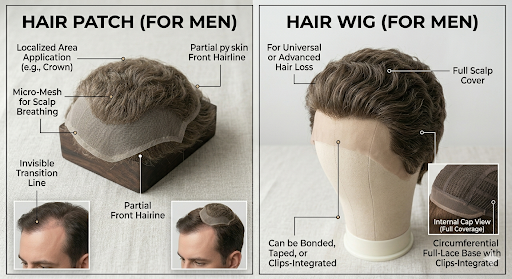
A hair patch is a custom unit that covers only the specific area where hair is missing. Not the full scalp — just the gap. Think of it like a dental crown. You don't replace your entire set of teeth to fix one. You only treat the affected area and fix the problem of integrity and aesthetic then and there itself.
A hair patch works on the same logic. It integrates with your existing hair, matches your natural color and texture, and fills in the area where growth has stopped. The hair around it is your natural hair. The patch blends in, and the entire look comes together well.
What Is a Hair Patch Made Of?
Two things determine how a hair patch looks and feels: the base it sits on, and the hair it's made with.
The Base
The base is the thin layer that contacts your scalp. The two most common types are skin base and lace base. Skin base units are made from polyurethane — a thin, transparent membrane that mimics the appearance of a scalp when the hair is parted. It gives a very natural hairline.
Lace base units use a fine mesh that allows better airflow, making them more comfortable in humid weather and ideal for extended daily wear. Some units use a hybrid of both: lace in the front for a natural hairline, skin base at the back. Your hair specialist will assess which base suits your scalp type and lifestyle before any recommendation is made.
The Hair
Human hair units and synthetic units are the two primary categories. Human hair (particularly Remy human hair, where the cuticle direction is preserved) behaves and moves exactly like your own hair. You can style it with heat, wash it, and oil it. Synthetic hair is more affordable and holds a style consistently, but it doesn't adapt to heat the way human hair does.
Human hair is the preferred choice for most patients because it blends well and gives a natural look. The highest-quality units use single-drawn or double-drawn hair, meaning each strand has a consistent root-to-tip direction — the same way hair grows on your head. This is what makes them look real.
How Is It Attached to the Scalp?
Attachment is where most people's concerns really live. The question does not stop at "will it stay on?" — it goes up to "will it stay on during a workout? In rain?" There are three standard attachment methods, and each one is chosen based on the person's daily life, not a default formula.
A double-sided adhesive strip applied along the perimeter of the patch. This is a beginner-friendly method and offers a strong hold for 2 to 4 weeks before reapplication. Easy to remove, easy to reapply.
Uses a liquid or gel glue (a skin-safe polymer) spread across the base for a full-contact bond. This creates the most movement-proof attachment and is preferred by people with active lifestyles. The hair patch in Delhi consultations at Evoke suggest this method for clients who swim or train.
Offers a mechanical, adhesive-free attachment that works well when a patch is being used part-time or for specific occasions. Less permanent but more flexible — ideal for patients who want the option to remove the patch themselves.
Who Is a Hair Patch Actually For?
An honest specialist will always tell you where a hair patch might work, and where it can create no difference at all. It works exceptionally well for:
Why Do Hair Specialists Recommend It First?
In specialist clinics that deal with hundreds of hair loss cases every month, a significant proportion of people who come in asking about hair transplants end up leaving with a hair patch recommendation. This happens mainly because, clinically, a patch is simply the better answer for their specific situation.
A hair transplant is a surgical procedure. It involves follicular extraction, incisions, a recovery period, and results that take many months for visible changes. For someone with stable, localised patchy hair loss, that is a disproportionate intervention.
A hair patch, by contrast, delivers results the same day. And it does not bring along with it the risk of surgical complications. If your hair grows back, or if your preferences change, there is no irreversible decision to live with.
Hair specialists assess the scalp, evaluate the pattern of loss, consider the patient's age and health profile, and then recommend what actually makes sense. For a large number of cases — particularly early-to-mid stage loss — the non-surgical hair restoration route is more practical than going under a scalpel.
Hair Patch vs. Hair Wig
A hair patch vs hair wig comparison always comes back to the same answer — a patch fixes only where the hair is missing, while a hair wig covers everything. The table below outlines the key differences between both prosthetics.
| Aspect | Hair Patch | Hair Wig |
|---|---|---|
| Coverage Area | Targets only the bald or thinning section | Covers the entire scalp |
| Purpose | Corrects partial hair loss | Replaces full hair loss |
| Integration with Natural Hair | Blends seamlessly with existing hair | Covers natural hair completely |
| Base Material | Customised to match scalp and hair density in a specific area | Standardised cap designed for full-head coverage |
| Attachment Method | Bonded or clipped onto a defined area | Worn as a full cap, often removable |
| Natural Appearance | More natural for partial hair loss due to blending | Can look less natural if not perfectly fitted |
| Customisation Level | Highly customised to individual scalp and hair pattern | Customisation varies but generally less precise for blending |
What to Expect When You Visit Evoke
The scalp's density, measured in follicular units per square centimetre, varies from person to person and across zones of the same head. A specialist uses this data to match the hair density of a patch to the density of your surrounding natural hair — which is why professional fitting looks different from off-the-shelf solutions.
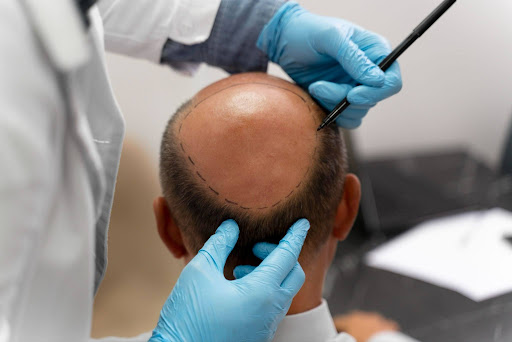
Scalp Assessment — A specialist looks at your scalp and assesses the extent of loss, the health of existing follicles, the texture and color of your hair, and the shape of your scalp. All of this informs whether a hair patch is the right recommendation.
Custom Fitting — The patch is customized to your measurements, color-matched to your exact shade, and cut and styled in a way that integrates with how you already wear your hair.
Aftercare Guidance — You leave knowing how to wash, condition, and maintain the unit at home — and when to come in for reapplication or cleaning.
Book Your Hair Patch Consultation at Evoke
Seven clinics across Delhi NCR. Every recommendation is built around your scalp's actual data — not a standard solution. Come in for a consultation and leave knowing your options clearly.