.svg)


Benefits of PRP Hair Treatment for Hair Loss
Not too long ago, hair loss was managed with home remedies like onion juice and oil massages, often guided by generational advice rather than medical understanding. Today, advancements in medical science have made it possible to approach hair loss in a more targeted way. PRP is a strong example of how far hair restoration has progressed.
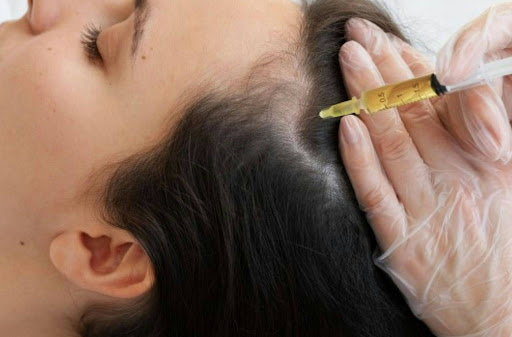
The Platelet-Rich Plasma (PRP) treatment involves drawing a small amount of blood, processing it in a centrifuge, and injecting concentrated growth factors directly into weakened hair follicles. According to a 2025 systematic review in Dermatologic Therapy, which evaluated outcomes across multiple clinical studies, PRP consistently showed positive results in increasing hair density and thickness, especially in early-stage androgenetic alopecia.
How PRP Hair Treatment Works: What to Expect
Everything that you read online brings your attention to the list of benefits without really highlighting the biological aspect behind this treatment. And when you don't understand the biology, you can't evaluate whether the treatment makes sense for your specific situation.
The specialists at Evoke see this gap every day in consultations. Patients come in having read ten articles, but they still don't know why PRP works. They've read that it works. That is not the same thing. Which is why this PRP treatment guide will help you out.
The Key Benefits of PRP Hair Treatment
Hair follicles don't die immediately. That's the part most people don't know. In early to moderate hair loss — whether from androgenetic alopecia, stress, or nutritional deficiencies — follicles enter a state called miniaturisation. They shrink. Their growth cycles shorten. They produce thinner, weaker strands. And eventually, they go quiet. But quiet is not the same as gone.
PRP for hair growth works best precisely at this stage. The growth factors in the platelet-rich plasma penetrate the scalp and reach the dermal papilla, the cluster of cells at the base of each follicle that controls growth. When those cells are stimulated, the follicle can shift back from telogen (resting) into anagen (active growth).
Specialists at Evoke notice this reactivation before patients do. They observe it in follicle density assessments done before and after a course of treatment. The follicles were there. They just needed a signal. PRP for hair growth is that signal.
Ask anyone who has completed even one or two PRP sessions what changed first. Almost universally, the answer is the same: they noticed less hair on the pillow. Not only that, but less in the drain and less in the brush too.
This is one of the most clinically significant benefits of PRP for hair. Plasma treatment for hair loss strengthens the root structure of existing hairs before it encourages new ones to grow. Think of it like reinforcing a fence post before planting new posts beside it.
The mechanism here involves the growth factors improving blood supply to the hair bulb and reducing the inflammatory signals that trigger premature shedding. Chronic low-grade inflammation around hair follicles is now understood to be a significant driver of both male and female pattern hair loss. Plasma treatment for hair loss addresses this directly. So when a patient says, "I feel like I'm losing less hair," that's biology responding — not just a placebo effect.
This benefit barely gets mentioned online, but the specialists consider it one of the most impactful effects of PRP. PRP injections improve vascularisation — more blood vessels grow into the scalp's dermal layer, and more oxygen and nutrients reach the follicles. This is not a cosmetic claim. Scalp blood flow is directly correlated with follicle health in published dermatological research.
Beyond circulation, PRP reduces chronic inflammation in the scalp. Many patients with hair loss (particularly women with diffuse thinning) have elevated scalp sensitivity: itching, tightness, and occasional flaking. These are signs of a scalp that is inflamed and stressed. After a course of PRP sessions, a significant number of Evoke patients report that their scalp feels calmer, less reactive, and more comfortable. Your scalp health improves with visible results.
New hair growth is the outcome everyone wants to talk about. But the more immediate, and in many ways more visible, result is the change in your existing hair. PRP stimulates the anagen phase, causing active hairs to stay in growth longer. This means each strand has more time to reach its full diameter. Patients often describe their hair as feeling "fuller" or "denser" within the first few months, even before they can see new strands coming in.
From a structural standpoint, the keratinocytes that build the hair shaft receive better nutrient delivery. The result is a strand that is physically thicker, less prone to breakage, and more resistant to external damage.
Non surgical hair treatment options like PRP are particularly compelling for this reason. You're not waiting for something entirely new to appear — you're watching what you already have get stronger in front of you. For patients in the early stages of thinning, that is often enough to restore confidence before they even reach the new growth phase.
One of PRP treatment's advantages is how well it pairs with other treatments. Patients undergoing a hair transplant are often recommended PRP alongside the procedure to accelerate graft survival and reduce inflammation at the transplant site. Those receiving GFC (Growth Factor Concentrate) therapy may alternate sessions with PRP for a layered approach. Others combine PRP with low-level laser therapy or topical treatments like minoxidil for compounding effects.
This flexibility makes PRP a foundational piece in many Evoke patients' treatment plans — not a standalone solution, but a treatment that amplifies whatever else is being done.
For many people, the reason they haven't pursued hair restoration is that the idea of a procedure is intimidating — and that is totally understandable. Stitches, recovery, time off work, visible signs of intervention. PRP sidesteps all of that.
This is a non surgical hair treatment: there is no incision. The entire session, from blood draw to the last injection, takes between 45 and 60 minutes. Mild redness or a feeling of pressure on the scalp may persist for 24 to 48 hours. After that, patients are fully back to their routine.
Non surgical hair transplant alternatives have grown significantly in demand over the last several years. PRP sits at the accessible, low-risk end of that spectrum, which is part of why it has become one of the most widely administered hair restoration treatments globally.
Who Is an Ideal Candidate for PRP Hair Treatment?
PRP is not the right answer for everyone. Specialists at Evoke are clear about this in consultations, and it's worth being equally direct here.
Strong Candidates
PRP hair treatment results are strongest in patients with early to moderate hair loss. Men experiencing the early stages of male pattern baldness — a receding hairline and thinning at the crown, but not complete loss in those areas — respond well. Women with diffuse thinning, postpartum hair loss, or stress-induced shedding are also strong candidates.
When PRP Is Not the Answer
If there is complete baldness in an area — meaning the follicles have been inactive for years and the scalp in that zone is smooth — PRP is unlikely to produce meaningful regrowth. The follicles need to still exist, even in a weakened state, for the growth factors to have something to work with.
PRP hair treatment cost is a factor many patients consider. The investment is there, but for the right candidate, the results justify it. For the wrong candidate, no treatment will deliver what they're hoping for, which is why diagnosis always comes before recommendation at Evoke.
What Patients Notice After PRP Treatment: Session-by-Session Results
Here is a realistic picture of what a typical course looks like. These are not promises — they are patterns.
Sessions 1–2
Sessions 3–4
Sessions 5–6
How PRP Hair Treatment at Evoke Is Worth It
Results from PRP come with consistency. The platelet-rich plasma hair treatment uses your own body's mechanisms to rebuild what thinning has taken. And that kind of repair, when it works, tends to hold.
The best PRP therapy in Delhi is not just about the injection itself — it's about the diagnostic precision before it, the session consistency during it, and the monitoring that happens throughout. At Evoke, that combination is what the team brings to every PRP consultation.
If you've been watching your hair thin and wondering whether now is the right time to act, you need to know that the earlier the intervention, the stronger the response. Follicles that are weakened but present are far easier to reactivate than those that have been quiet for years.
Book a consultation at Evoke Hair Clinic
Do not commit to a treatment immediately — but consult to know where you actually stand. Doctor-led diagnosis, personalised treatment plans, and a diagnosis-first approach before any recommendation is made.