.svg)

QR678 Hair Treatment: How It Works, Who It's For & What to Expect
You have probably tried products. Maybe a Traya course. Maybe minoxidil for a few months. Something worked partially, then plateaued. QR678 is what comes after that plateau. It is a clinically administered growth factor therapy injected directly into the scalp to wake up follicles that have started shrinking but have not yet gone dormant.
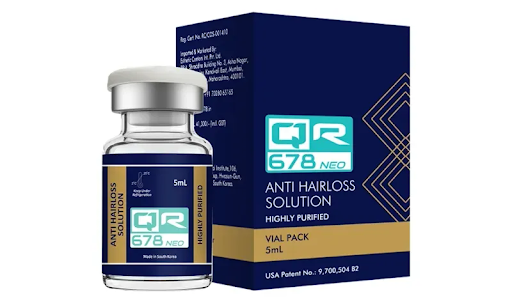
QR678 is a proprietary, non-surgical hair restoration treatment delivered through scalp injections. It uses a pre-formulated blend of growth factor proteins to stimulate follicular activity and reduce active hair fall.
How Does QR678 Treatment Actually Work for Hair Loss?
QR678 works by delivering growth factors directly into the dermal layer of the scalp, where hair follicles sit.
The formulation contains a defined blend of peptides and growth-stimulating biomolecules, including vascular endothelial growth factor (VEGF), insulin-like growth factor (IGF), and other follicular-signalling proteins. These stimulate follicular cell proliferation, improve blood supply around the hair bulb, and shift miniaturised follicles from the telogen resting phase toward an active anagen growth phase.
Unlike PRP and GFC, which use preparations derived from the patient's own blood and therefore vary with each person's platelet count, QR678 uses a pre-formulated proprietary compound. Every session delivers the same defined concentration of active biomolecules, regardless of individual variation.
Follicles that are miniaturised but still biologically active are the primary target. QR678 cannot reactivate follicles that have permanently ceased function. The stage of hair loss when treatment begins directly determines how much the protocol can achieve.
What Happens During a QR678 Session at a Clinic?
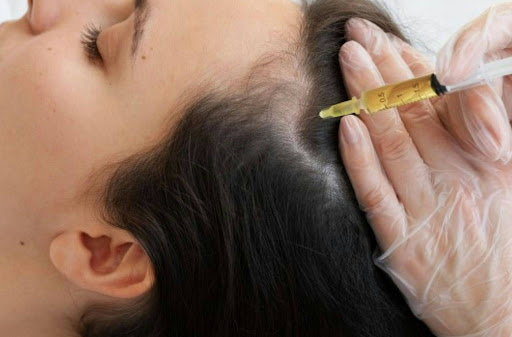
The session begins with a scalp assessment to confirm the treatment zones. The scalp is cleaned, the formula is loaded into a fine-gauge syringe, and injected at multiple points across the thinning zone.
A complete session takes 30 to 45 minutes. There is no downtime. Most patients resume normal activity the same day.
Mild redness and warmth across the injected zones are common in the first few hours and are normal indicators of the biological response the treatment is designed to trigger. The scalp returns to its normal appearance within 12 to 24 hours.
Why Is QR678 Specifically Used for Hair Thinning Concerns?
Hair thinning in its early and mid-stages involves follicular miniaturisation. DHT or nutrient deficiency signals cause the hair growth cycle to shorten progressively, producing finer and shorter hairs before the follicle eventually becomes dormant.
DHT-Pattern Hair Loss
For DHT-pattern loss, QR678 introduces the growth factor signals that the affected follicle is no longer receiving. The therapy does not block DHT directly, making it most effective alongside DHT management rather than as a standalone intervention.
Stress and Hormonal Thinning
For thinning driven by stress, nutritional deficiency, or post-partum hormonal change — where the root cause is manageable and follicles are not under chronic DHT pressure — QR678 can function as a more complete primary intervention.
Who May Be a Suitable Candidate for QR678 Hair Treatment?
How Many QR678 Sessions Are Typically Recommended for Results?
Initial Treatment Phase
Most patients are recommended between six and ten sessions during the initial phase, spaced two to three weeks apart. Closer spacing maintains a continuous growth factor stimulus across the follicular population.
The Maintenance Phase
After the initial phase, maintenance sessions at longer intervals sustain the follicular response. Frequency depends on how the scalp has responded and whether the underlying cause has been addressed.
Realistic Outcome Expectations
QR678 produces gradual improvement. Visible reduction in active hair fall typically occurs between sessions three and five. Visible density improvement becomes apparent between months three and six.
Visible reduction in active hair fall — the first measurable sign that the treatment is working at the follicular level.
Visible density improvement becomes apparent — the cumulative result of sustained follicular stimulation across the initial phase.
QR678 vs PRP: Understanding Core Protocol and Clinical Differences
| Dimension | QR678 | PRP |
|---|---|---|
| Source of Growth Factors | Pre-formulated proprietary compound | Patient's own blood-derived plasma |
| Consistency Across Sessions | Standardised per session | Varies with platelet count |
| Blood Draw Required | No | Yes |
| Availability | Licensed clinics only | Most hair clinics |
Where QR678 Has the Advantage
Patients with a low platelet count get a more consistent growth factor dose through QR678 than through PRP, because QR678 does not depend on what their blood produces.
When PRP Works Better
High platelet counts mean PRP can deliver a higher and more personalised growth factor concentration than any fixed-formula protocol. For these patients, their own biology is the advantage.
How Evoke Clinic Approaches Personalised Hair Restoration and Planning
At Evoke, QR678 is not offered as an isolated protocol. It is recommended as part of a broader restoration plan that begins with a scalp assessment identifying the pattern, stage, and root cause of the thinning.
Root Cause Diagnosis First — Dr. Aishwarya evaluates whether the thinning is DHT-driven, hormonally influenced, nutritionally related, or stress-triggered before recommending which intervention — or combination of interventions — is appropriate for that specific scalp.
QR678 Alone Falls Short for DHT Loss — QR678 does not block DHT. A patient receiving QR678 for DHT-pattern loss without concurrent DHT management will find the growth factor stimulus working against a biological signal that continues to miniaturise the follicles.
Combined Planning in Practice — A scalp assessment at Evoke translates the root cause diagnosis into a treatment plan that addresses stimulation and the underlying driver simultaneously — preventing growth factor stimulus and unmanaged DHT from working against each other.
Begin with a Scalp Assessment, Not a Treatment
Every QR678 recommendation at Evoke follows a scalp assessment that identifies the pattern, stage, and root cause of thinning. Book a consultation and leave knowing exactly where your hair loss stands and what the right next step is for your specific scalp.