.svg)

Types of Hair Patches: Lace, Mono, Skin Base & Hybrid Systems Explained
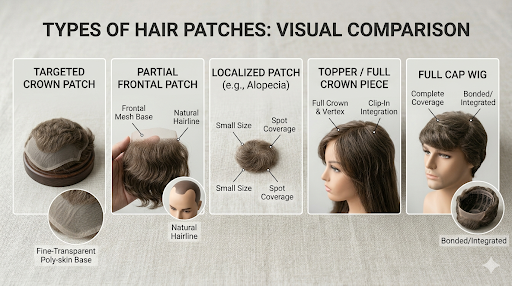
Hair patches are non-surgical hair replacement systems that cover a specific area of the scalp rather than the entire head. They are attached to the scalp using medical-grade adhesives or clips and blend with existing hair at the perimeter.
The different types of hair patches available today are distinguished primarily by their base material, which determines how they feel against the scalp, how natural they appear in daylight, and how long they last under daily wear conditions.
What Is a Hair Patch and How Does It Work?
A hair patch is a small, custom-made hair prosthetic that sits only on the area where your hair has thinned or stopped growing. It is not a full wig. Your natural hair on the rest of your scalp stays exactly as it is, and the patch blends into it at the edges. Most people looking at you from a normal distance cannot tell where your natural hair ends and the patch begins.
The patch attaches to your scalp using a medical-grade adhesive or clips, depending on which method your clinic recommends for your scalp type. It is shaped to match the exact area of your loss, not cut from a generic template.
The Base Material
Every hair patch is built on a base, and the base is what everything else depends on. Think of it as the fabric that holds the hair. Human or synthetic hair strands are individually tied or implanted into this base, one by one. The base material determines four things:
Weight on Your HeadHow heavy the patch feels during daily wear — lighter bases are more comfortable over long periods.
Airflow to Your ScalpHow much air reaches your scalp through the base — critical for comfort in warm and humid conditions.
Scalp VisibilityWhether your scalp skin is visible through the base — which directly affects how natural the hair appears to be growing.
Lifespan Under Daily WearHow long the base holds up before needing replacement — determining the long-term cost and maintenance commitment.
Why Do Different Types of Hair Patches Exist Today?
No single base material performs equally well across all use cases. A patch chosen for maximum natural appearance may sacrifice durability. One chosen for durability may restrict breathability.
The variation across patch types reflects the different priorities of different wearers, and the range available today allows for a much closer match between the wearer's lifestyle and the patch's performance characteristics. The science behind hair patches shows that base material construction is the single variable that determines how long a patch maintains its appearance under daily wear conditions.
Lace Hair Patch
A lace base patch uses a fine mesh of French or Swiss lace as the foundation into which hair is hand-knotted. The lace is thin enough to be nearly invisible against the scalp when attached with adhesive, creating the illusion of hair growing directly from the skin. This produces the most natural-looking hairline of any patch type, particularly in direct light or when the wearer styles their hair away from the face.
Swiss lace is finer and more transparent than French lace, producing a slightly more natural appearance at the cost of reduced durability. French lace is more resilient and better suited to daily attachment and removal. Both types are significantly lighter than mono or skin base systems and allow more airflow to the scalp, making them a practical choice in warm and humid conditions like Delhi summers.
Mono Hair Patch
A monofilament base uses a thin, durable polyester or nylon mesh rather than lace. Each hair strand is knotted individually into the mesh, which is less transparent than lace but significantly more resistant to daily wear. The monofilament base maintains its structural integrity through repeated adhesive application and removal cycles, making it better suited to patients who prioritise longevity over maximum scalp transparency.
Mono patches typically last three to six months with proper care. The scalp does not show through the base as clearly as with lace, which slightly reduces the appearance of hair growing naturally from the skin. In practice, this distinction is most noticeable under close inspection or in direct overhead light. At normal social distances, a well-fitted and properly blended mono patch reads as natural hair.
Skin Base Hair Patch
A skin base patch uses a thin polyurethane film — often called a skin or poly base — rather than mesh. The film is transparent when pressed against the scalp, creating a seamless scalp-coloured appearance that requires no adhesive at the perimeter because the film itself bonds directly to the skin. This produces the most natural scalp simulation of any base type, as the polyurethane mimics the visual texture and colour of skin far more closely than mesh materials.
Skin base patches are the preferred choice for patients whose thinning covers a large area and who need the centre of the patch to appear indistinguishable from their natural scalp.
Hybrid Hair Patch Systems Explained
Hybrid patches combine two or more base materials within a single unit, pairing the strengths of each where they matter most. They are the most technically sophisticated option and are typically recommended for patients with larger loss areas or specific appearance requirements.
The front of a hybrid system uses a lace base, producing a natural-looking hairline where transparency against the scalp is most visually important — at the forehead and temples where the hairline is most visible in daily life.
The crown and back of the patch use a monofilament or skin base, which is more durable than lace and better suited to the areas where the patch contacts the scalp most firmly during daily activity.
Hybrid systems are most suitable for patients with extensive thinning who need both a convincing hairline and reliable daily coverage across a larger surface. Patients with larger loss areas benefit most from hybrid configurations that match base type and construction to their specific scalp.
Hair Patch vs Wig: Coverage and Key Functional Differences
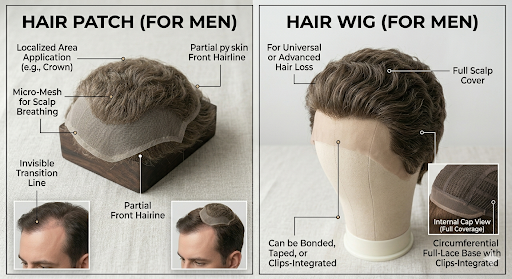
Coverage area is the defining structural difference between a patch and a wig, and it determines which system is appropriate for a given type and extent of hair loss.
| Situation | Hair Patch | Wig |
|---|---|---|
| Localised Hair Loss | More natural outcome — surrounding natural hair integrates with the patch at the edges for a seamless result | Requires natural hair to be pinned underneath, creating bulk and an unnatural hairline edge |
| Very Advanced Hair Loss | Fitting a patch large enough to cover the full scalp is more complex and expensive | More appropriate when no natural hair remains to blend with — a full wig system is more practical |
| Any Partial Hair Loss | Consistently produces a more convincing result at lower weight and with better scalp comfort — reads as natural hair at normal social distances | Less natural for partial loss — designed for full coverage, not edge blending |
Which Hair Patch Type May Be Suitable for Different Lifestyles?
Lifestyle factors are as important as scalp condition in determining which patch type performs best for a given wearer.
Lace base in a French lace variant offers the best breathability and lightest weight, reducing sweat buildup and scalp discomfort during physical activity. The shorter lifespan is offset by more frequent replacement, which is straightforward if a maintenance schedule is established with the clinic.
Lace and mono base patches both outperform skin base in humid conditions because the mesh construction allows moisture to disperse rather than trap against the scalp. Skin base patches in high humidity can cause adhesive to loosen faster and increase heat retention.
Mono base offers the best balance of durability and natural appearance for a patient who wants a patch that holds for three to six months without frequent reattachment appointments.
Lace front or hybrid systems produce the most convincing hairline appearance in direct light and at close range. For patients who primarily need the patch for specific high-visibility situations, a lace front system is the appropriate choice.
How Evoke Hair Clinic Approaches Personalised Hair Patch Solutions
Hair patch consultations at Evoke begin with a scalp analysis that maps the area of loss, the density and colour of surrounding natural hair, and the scalp skin tone visible through the base material. Every specification follows from what the scalp assessment shows.
Matching Patch to Scalp — The patch base type, hair density, and texture are selected to match the surrounding natural hair, so the boundary between patch and natural hair reads as a seamless continuation. No standard specification is applied uniformly across patients.
Hair Quality and Styling — Hair patches at Evoke use human hair exclusively, which allows styling with heat tools, colouring, and the full range of daily handling that natural hair supports. Synthetic hair cannot be heat-styled and degrades faster under daily wear conditions.
Local Consultation and Fit — The full consultation and customisation process covers local fit requirements and maintenance schedules specific to NCR conditions, accounting for seasonal humidity and lifestyle factors that affect adhesive performance.
Things Every Patient Should Know Before Choosing a Hair Patch
Four considerations matter most for patients approaching a hair patch decision for the first time.
Maintenance Schedule Commitment
Every hair patch requires periodic reattachment, cleaning, and eventual replacement. The frequency depends on the base type: lace patches require reattachment every two to four weeks, while mono and skin patches can last longer between service appointments. A patient who cannot maintain a regular service schedule will find the patch degrades faster and looks less natural over time.
Scalp Health First
Active scalp conditions including seborrheic dermatitis, psoriasis, or folliculitis should be treated and stabilised before a patch is fitted. Attaching adhesive to an inflamed scalp worsens the inflammation and prevents the adhesive from bonding correctly. A scalp assessment before fitting confirms whether the scalp is ready for a patch system.
Realistic Appearance Expectations
A well-chosen and correctly fitted hair patch looks natural under normal conditions. It does not look natural under conditions it was not designed for — including swimming without a protective cap, extreme physical exertion that causes heavy sweating and adhesive loosening, or very close inspection of the hairline edge under direct light. Setting accurate expectations before fitting prevents dissatisfaction with a technically correct result.
Bridge to Clinical Treatment
Hair patches are a non-surgical coverage solution, not a hair restoration protocol. They do not stimulate follicular activity or slow the progression of hair loss. Patients with active androgenetic alopecia who fit a patch without also addressing the underlying DHT-driven loss will find their natural hair continuing to thin underneath the patch. A patch covers the loss — it does not treat the cause.
Not Sure Which Patch Type Is Right for You?
A scalp assessment at Evoke maps your loss area, surrounding hair density, scalp skin tone, and lifestyle requirements before any recommendation is made. Every specification follows from what your scalp assessment shows — not a standard template.