.svg)

Hair Patch vs Hair Wig: Which One Is Right for You?
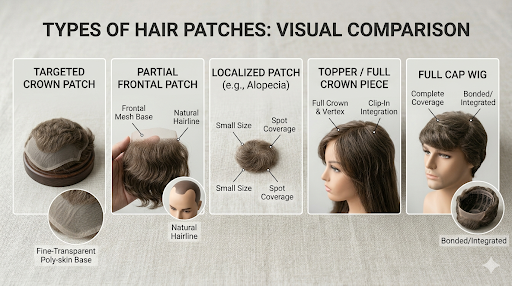
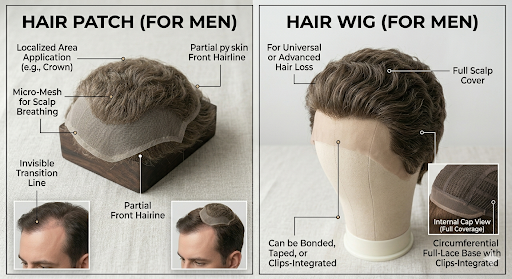
A hair patch covers a specific area of loss and blends with your natural hair. A wig covers the entire scalp and replaces all of it. If you still have natural hair on most of your scalp, a patch almost always produces a more convincing and more comfortable result than a wig.
Both look identical in product photos, which is where most of the confusion starts. The difference only becomes clear when you understand what each unit does for you from an aesthetic and durability perspective.
The Short Answer
For partial hair loss with natural hair remaining elsewhere on the scalp, a patch is almost always the better choice — more natural, more breathable, and easier to maintain daily. A wig makes sense when hair loss is near-total and there is little natural hair left to integrate with.
What Is a Hair Patch and How Is It Worn?
A hair patch is a custom-made unit fitted precisely to the area where your hair has thinned or stopped growing. It bonds to the scalp using medical-grade adhesive or clips, and the edges of the patch blend into your surrounding natural hair so that there is no visible boundary between the two.
Your natural hair stays exactly where it is. You are not concealing it, pinning it away, or replacing it. The patch fills the gap, and the rest of your hair does what it has always done.
What Is a Hair Patch?
A partial unit that covers only the thinning or bald zone. It bonds directly onto the affected scalp area, its edges feathering seamlessly into your surrounding natural hair.
Because your real hairline is preserved and your natural hair frames the unit on all sides, the result is integrated — not placed-on-top.
What Is a Hair Wig?
A full-coverage unit that sits over the entire scalp. Everything underneath — your natural hair — has to be tucked and pinned under a wig cap before the wig goes on.
For someone who still has meaningful hair on most of their scalp, this creates added bulk, restricted airflow, and a hairline that must be fabricated rather than grown.
Hair Patch vs Hair Wig: Coverage and Fitting Differences
Coverage area is the single structural variable that determines which system is appropriate for you. How much natural hair you still have, and where the loss is, answers the question before anything else does.
Localised Hair Loss
With a patch, your natural hair surrounds the replacement on all sides. It anchors the patch visually, it moves with it, and it makes the result look like it belongs to your scalp rather than sitting on top of it.
Patients across Delhi NCR consistently find that a hair patch in Delhi produces a more integrated result than a full wig for the same coverage area, precisely because of this surrounding natural hair.
Near-Total Hair Loss
When hair loss is very advanced and very little natural hair remains, the calculus changes. A patch sized to cover the full scalp becomes unwieldy and expensive to maintain.
At that stage, a full wig is more practical and more economical. The absence of natural hair to blend into removes the primary advantage a patch holds.
Which Option Looks More Natural: Hair Patch or Wig?
For partial hair loss, a patch wins on naturalness by a significant margin. The reason comes down to where your real hairline is.
A patch does not need to create a hairline. Your hairline already exists. The patch fills the thinning zone, and the natural hair around it does the rest. There is no visible edge to manage.
A wig has to fabricate a hairline from scratch across your entire forehead and temples. Getting that edge to match your skin tone, scalp texture, and hair density is technically difficult. Even with expensive systems, it is a fabrication — and fabrications under the wrong light or at the wrong angle reveal themselves.
A lace front wig uses a transparent lace base at the hairline to mimic the appearance of hair growing from the scalp. When properly applied, it does produce a convincing hairline. But your natural hair still goes under the cap. The hairline may look right — everything behind it is still covered.
A patch lets your real hair stay where it grows and do what it does naturally.
Comfort and Daily Wear in Delhi and Gurgaon's Climate
For daily wear in Delhi and Gurgaon, a patch is substantially more comfortable than a wig through most of the year. In this climate, it is a practical daily reality — not a minor lifestyle preference.
Airflow & Breathability
A patch sits on the loss zone only. The rest of your scalp is open, uncovered, and breathing normally. A wig creates a sealed surface across the entire scalp, restricting airflow uniformly from ear to ear.
Climate & Humidity
From May through September, the months that define life in Delhi NCR, a full wig becomes genuinely difficult to wear comfortably. Sweat under a wig cap loosens the adhesive, irritates the scalp, and creates a level of discomfort that is hard to resolve without taking the wig off entirely. A patch lets perspiration disperse through the natural uncovered scalp while keeping the loss zone covered. hair patch in Gurgaon specifically addresses how adhesive selection, maintenance scheduling, and base material choice adapt to the demands of summers and post-monsoon humidity in the NCR.
Active Lifestyle
If you exercise, commute in heat, or spend significant time outdoors, a full wig is a daily management exercise. A patch is not. That difference accumulates quickly over weeks of daily wear.
What Maintenance Does Each Hair Replacement System Actually Require?
Both systems need regular care, but the effort involved differs significantly in frequency, complexity, and what happens when you skip a cycle.
| Factor | Hair Patch | Hair Wig |
|---|---|---|
| Reattachment Frequency | Every 2–4 weeks for lace base; longer for mono and skin base | Similar adhesive cycle, but repositioning a larger, heavier unit each time |
| Base Lifespan | 1–6 months depending on base type; lace wears fastest, mono lasts longest | Comparable quality-for-quality duration |
| When Base Deteriorates | Only the patch is affected — replace the patch, not your whole look | The entire unit is compromised at once when the base goes |
| Mechanical Stress on Bond | Lower — smaller footprint, less movement stress | Higher — larger unit creates more strain on adhesive during repositioning |
| At-Home Care | Sulfate-free wash, wide-tooth comb, light conditioner on strands; air dry | Similar product requirements; more time-consuming due to full coverage |
Who Is the Right Candidate for a Hair Patch?
A patch works best when there is natural hair to integrate with. If your loss is localised and your scalp still has density everywhere else, a patch gives you a result that feels continuous with your own hair rather than something placed on top of it.
Who Is the Right Candidate for a Full Wig?
A wig becomes the right choice when the goal is full coverage and there is very little natural hair left that needs to be preserved or integrated.
Important Things to Know Before Making Your Final Choice
Three variables consistently determine whether a patient ends up satisfied or disappointed with their choice. None of them are about the product quality.
Extent of Loss
The single most important factor is how much natural hair you still have. If meaningful natural hair remains across most of your scalp, a patch almost always produces a better outcome than a wig. The more advanced the loss, the more the calculation shifts toward full coverage.
Climate as a Practical Factor
In Delhi NCR summers and monsoon months, scalp ventilation is a daily wearability issue — not a minor comfort consideration. Mesh-base patches manage heat and humidity significantly better than a sealed wig surface. Factor in June through September specifically when making a year-round decision.
Consult Before You Purchase
The most common source of dissatisfaction with both patches and wigs is not the product itself — it is a mismatch between product spec and the wearer's scalp. Density, colour, base type, and size all have to be matched precisely. Buying without a professional assessment means guessing on every one of those variables.
How Evoke Hair Clinic Approaches Personalised Hair Replacement Consultations
The decision between a patch and a wig is not something that should be made from a product page. It depends on exactly how much hair remains, where the loss is concentrated, what the scalp condition looks like, and what daily maintenance a patient can realistically sustain. At Evoke, that decision follows a scalp assessment that maps all of these variables before any recommendation is made.
The journey from hair loss to hair patch walks first-time clients in Gurugram through each step from initial assessment through base type selection to the final fitting, so that every specification follows from what the scalp actually shows.
Scalp Assessment — A specialist evaluates the extent of loss, the health of existing follicles, your hair's texture and colour, and the shape of your scalp. All of this informs whether a patch or wig is the right recommendation — and which base type suits your daily life.
Custom Fitting — The chosen unit is sized to your measurements, colour-matched to your exact shade, and cut and styled to integrate with how you already wear your hair. No off-the-shelf guesswork.
Aftercare Guidance — You leave knowing how to wash, condition, and maintain the unit at home — and when to return for reattachment or a deep clean. Adhesive type and maintenance schedule are adjusted for NCR seasonal demands.
Book Your Hair Replacement Consultation at Evoke
Seven clinics across Delhi NCR. Every recommendation is built around your scalp's actual data — not a standard solution. Come in for a consultation and leave knowing exactly which system, which base, and which attachment method fits your life.