.svg)


Hair Patches vs Hair Transplant: Which One Should You Choose?
A hair patch and a hair transplant serve distinct hair-related situations. A patch suits patients where immediate coverage, reversibility, or a specific scalp profile makes it the appropriate path. A transplant suits patients where donor density, loss stability, and a 12-month result window are all present.
The decision between them is made at the scalp level, where the clinical profile determines which fits as a suitable solution.
The Core Distinction
One works with follicles that still exist. The other replaces what follicles could previously provide. Starting from that distinction makes the rest of the comparison easier to read accurately — and prevents choosing the wrong solution for the wrong reasons.
Understanding Hair Patches and Hair Transplants
The instinct to compare a patch and a transplant on appearance alone misses the difference that determines which treatment is appropriate for your situation. Starting from how each one functions produces the right frame for the rest of the comparison.
What a Patch Does
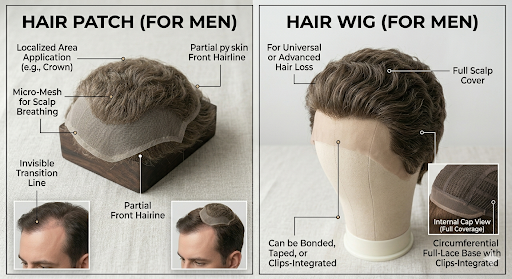
A hair patch is a non-surgical system made from natural human hair bonded to an ultra-thin skin base, attached to the scalp over the area of loss using medical-grade adhesive. It delivers immediate coverage regardless of loss stage and is fully reversible at any point.
The science behind how a hair patch base creates an undetectable result is primarily about base material, edge blending, and density calibration at the fitting.
What a Transplant Does
A hair transplant permanently relocates DHT-resistant follicles from the donor zone to the thinning or bare area. The relocated follicles grow hair for life and require no ongoing maintenance beyond standard scalp care after healing.
The procedure uses local anaesthesia and produces results over a 10 to 14 month timeline rather than immediately.
Hair Patch vs Hair Transplant: Full Comparison
The table below maps every meaningful clinical and practical variable side by side. The FUE versus FUT hair transplant method comparison and how each affects the scar profile and recovery timeline is relevant to any patient for whom the transplant option is being evaluated.
| Factor | Hair Patch | Hair Transplant |
|---|---|---|
| Procedure Type | Non-surgical; no anaesthesia required | Surgical; local anaesthesia used throughout |
| Result Timeline | Immediate coverage on the day of fitting | Visible regrowth from month 4; full result at 10 to 14 months |
| Permanence | Reversible; requires re-bonding every 4 to 8 weeks | Permanent; transplanted follicles do not shed |
| Maintenance Commitment | Monthly clinic visits for re-bonding; base replacement every 6 to 10 months | No regular maintenance after initial healing |
| Annual Cost | Rs 36,000 to Rs 96,000 per year in servicing | Single procedure: Rs 80,000 to Rs 2,50,000 depending on graft count |
| Candidacy | Any stage of loss including where donor density is insufficient | Requires stable pattern and adequate donor density |
| Scar Risk | None | Tiny circular scars in FUE; linear scar in FUT |
| Activity After Treatment | Immediate return to activity | Restricted activity for 7 to 14 days post-procedure |
Who Is a Good Candidate for Each Option?
The candidacy question is not about which option sounds preferable. It is about which one the scalp and hair loss pattern can actually support. Getting this wrong in either direction wastes money and time.
Hair Patch Is the Right Choice When…
Hair Transplant Is the Right Choice When…
Hair Patch vs Hair Transplant: Cost, Maintenance & Long-Term Value
The cost comparison between a patch and a transplant is only accurate when calculated over the same time horizon. A single-session comparison gives the wrong answer.
Patch Annual Cost
Re-bonding visits every 4 to 8 weeks at Rs 3,000 to Rs 8,000 per visit, plus base replacement every 6 to 10 months.
Over three years, this totals between Rs 1,44,000 and Rs 3,00,000 depending on the servicing schedule.
Transplant Total Cost
A hair transplant in the mid-range clinical bracket in Delhi NCR runs between Rs 80,000 and Rs 2,50,000 for the full procedure.
After the initial healing period, there is no mandatory recurring cost unless maintenance treatments such as GFC or PRP are added.
Which Costs Less?
For a strong transplant candidate, the transplant becomes more cost-efficient beyond a three to four year horizon.
For a patient whose profile makes a patch the correct recommendation, the recurring servicing cost is the trade-off for immediate coverage without surgery.
The hair transplant aftercare protocol and patch maintenance schedules serve different patient types at different stages of loss.
How to Choose Between a Hair Patch and Hair Transplant
The decision between a patch and a transplant reduces to three questions. Answering them honestly with a specialist produces the right recommendation faster than researching each option separately.
Active progression means the transplant result will look uneven in a few years, which makes the patch the more practical interim choice.
Insufficient donor reserve makes a transplant either impossible or one that requires a second session to correct.
If the timeline matters, the patch answers that. If permanence is the priority, the transplant does.