.svg)

Male Pattern Baldness: Comprehensive Guide to Causes & Treatments
More hair on your pillow than on your head. A forehead that seems to grow a little every month. If you have been noticing this, you probably have balding signs. The sooner you accept that, the sooner you can actually do something about it.
What catches most men off guard is how early it starts now. In Delhi, men are walking in at 19 and 22 with patterns that a generation ago would not have shown up until their late thirties. Nationally, 58% of Indian men between 30 and 50 are affected. However, there is a lot more working against your hair than just your genes. This guide breaks it all down.
What is Male Pattern Baldness?
Male pattern baldness, medically called androgenetic alopecia, is the most common form of hair loss in men. Unlike hair loss caused by stress, nutrition, or medical conditions, this one is driven by genetics and a hormone called DHT. If you are unsure where your hair loss falls, understanding your Baldness Concern is the right place to start.
DHT (Dihydrotestosterone) is a byproduct of testosterone. In men who are genetically sensitive to it, DHT slowly shrinks hair follicles over time. Each hair that grows back comes in thinner and shorter than the last, until the follicle goes dormant. The hair is not gone — it has just stopped growing.
Dermatologists use the Norwood scale to track how far along this process is:
Recognizing the Signs: Symptoms of a Receding Hairline & Thinning Crown
The signs are there before the loss is obvious. Knowing what they look like, and what they actually mean, is what separates early action from late regret.
Early Warning Signs Most Men Miss
Most men notice something is off before they can clearly explain what has changed. Here is what to look for.
How to Tell if It's Genetic Baldness or Something Else
Not all hair loss is the same. Misidentifying the type is the most common reason men spend months on treatments that were never going to work for them.
| Type | Pattern | Common Triggers | Key Difference |
|---|---|---|---|
| Androgenetic Alopecia | Temples first, then crown | Genetics, DHT sensitivity | Back and sides unaffected |
| Telogen Effluvium | Whole scalp, no fixed pattern | Stress, poor diet, illness, sleep issues | Starts 2 to 3 months after trigger |
| Alopecia Areata | Circular patches | Autoimmune response | Not related to DHT at all |
Why Do Men Lose Hair? Male Pattern Baldness Causes
Hair loss rarely has one cause. For most men it is a combination of factors — some you are born with and some affected by your lifestyle and environment.
DHT is a hormone that gradually shrinks hair follicles in men who are genetically sensitive to it. This sensitivity can come from either parent, not just your mother's side. Multiple genes are involved, which is why two brothers can have completely different hairlines.
Delhi's AQI crossed 491 in November 2024. At that level, PM2.5 particles reduce the proteins responsible for keeping follicles in the growth phase. Research also links heavily polluted cities to higher rates of alopecia areata compared to rural areas.
Hard water leaves mineral deposits on the scalp, blocks follicle openings, and strips natural oils. Over time this causes dryness, inflammation, and brittle hair. Maintaining good scalp health from the start is one of the most overlooked steps in preventing accelerated hair loss. Hard water does not cause baldness alone but it works against any treatment you are doing.
Chronic stress pushes follicles out of the growth phase and into shedding. The hair fall starts 2 to 3 months after the stressful period, so most men never connect the two. A study of 150,000 users found 68% of hair loss sufferers reported high stress.
Iron, zinc, vitamin D, and protein deficiencies are among the most common findings in hair loss patients. Zinc absorption is blocked by phytic acid in chapati. Vitamin D deficiency is widespread despite India's climate. These do not show symptoms — but they show in your hair.
Most patients arrive after 12 to 18 months of trying things that did not work. Castor oil delays diagnosis. Minoxidil stopped abruptly and caused worse shedding. Repeated keratin treatments damage the scalp. The issue is not trying to fix it — it is fixing the wrong thing.
FDA-Approved Medications & Medical Management
There are two medications that are FDA-approved for male pattern baldness. They can slow it down and in some cases reverse early loss, but they are not a permanent fix.
Minoxidil
Applied to the scalp. It extends the growth phase and works best at maintaining existing hair. Results stop the moment you stop using it.
Finasteride
An oral medication that blocks DHT production. It slows follicle shrinkage but carries side effects that need doctor oversight.
Reversing Hair Thinning Without Surgery
Not every case of hair loss needs a transplant. For men in the early to mid stages, non-surgical treatments can slow loss, improve density, and in some cases reverse thinning. Here are the options available at Evoke:
GFC (Growth Factor Concentrate) Therapy
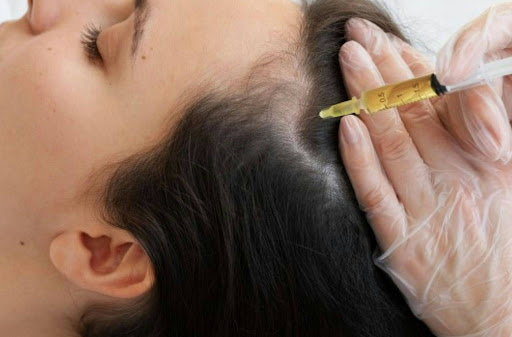
Your own blood is processed to extract concentrated growth factors and injected into the scalp. It stimulates dormant follicles and strengthens existing hair. Best for early to mid stage loss. Most patients see visible improvement by month 3, with stronger results at 6 and 12 months.
PRP (Platelet-Rich Plasma)
Similar to GFC in that it uses your own blood, but PRP uses a broader platelet concentration rather than isolated growth factors. Best for early stage loss and as a maintenance treatment alongside other therapies.
QR678
A patented growth factor formulation injected into the scalp. Clinically developed specifically for androgenetic alopecia and telogen effluvium. Works well for both men and women and is particularly effective in the early stages of pattern hair loss.
Low Level Laser Therapy (LLLT)
Uses low level laser light to stimulate follicle activity at a cellular level. Non-invasive, painless, and works best as an early stage or maintenance treatment. Often combined with other treatments for better results.
GFC with Microneedling
Microneedling creates micro channels in the scalp that allow growth factors to penetrate deeper. The combination improves absorption and results compared to GFC alone. Suited for men who have not responded fully to GFC on its own.
Advanced Hair Transplant Technologies at Evoke
For men at Stage 4 and above, or those who have not responded to non-surgical treatments, a hair transplant is often the most effective long-term solution. At Evoke, two techniques are available depending on your coverage needs and preferences.
Follicular Unit Extraction
Individual hair follicles are extracted from the back and sides of the scalp and transplanted to thinning areas. Evoke's Bio-FUE Hair Transplant technique ensures no linear scar, faster recovery, and natural looking results.
Best suited for men at Norwood Stage 4 and above, younger patients, and anyone who wears their hair short.
Follicular Unit Transplantation
A strip of hair-bearing skin is removed from the donor area and individual follicles are extracted from it. This allows for a larger number of grafts in a single session, making it the better option for men who need significant coverage.
It does leave a faint linear scar at the back of the scalp, which is easily covered by surrounding hair. More cost-effective than FUE for high-graft cases.
How an Evoke Dermatologist Tailors Your Male Pattern Baldness Treatment
Male pattern baldness treatment works when it is built around the right cause. At Evoke, every consultation begins with a scalp scan and blood panel. The findings shape the plan — nothing else.
Root-Cause First — Someone losing hair from DHT needs a completely different approach than someone losing it from stress or a nutritional gap. At Evoke, that difference is identified before any treatment is recommended. Not after.
Right Treatment, Not the Default Treatment — Not every patient needs a transplant. Some need medication. Some need a non-surgical protocol. What you need is determined by what your scalp is actually showing, not by a general assessment.
Digital Trichoscopy: The Diagnostic Starting Point
Visit an Evoke Hair Clinic in Delhi, Gurgaon, or Noida
With 7 clinics across Delhi NCR, getting a proper hair loss diagnosis has never been more accessible. Each location offers the same diagnostic-first approach: scalp scan, blood work, and a male pattern baldness treatment plan built specifically around your cause.
Book a Free Hair Loss Consultation at Your Nearest Evoke Clinic
Walk in with questions. Walk out with a plan. Expert diagnosis at 7 locations across Delhi NCR — no obligations, completely free.
Frequently Asked Questions