.svg)

Golden Mirage Hair Patch in Delhi: What It Is and Whether It Is Right for You
Most individuals build hair loss anxiety through everyday situations where their confidence around facial aesthetics starts taking minor and gradual hits. Most scenarios involve a meeting room with bright lighting, a social event where photographs are unavoidable, or a haircut that no longer sits the way it used to.
Over time, the search moves beyond temporary fixes toward solutions that feel dependable enough to fit into real life naturally. For many people, surgical treatments still feel like a big commitment in terms of recovery, cost, or long timelines for visible results. That is where interest in non-surgical hair restoration options begins to grow.
The Golden Mirage hair patch is a preferred choice for many people that are looking for immediate, natural-looking coverage with only a slight overhaul in their routine. Read on to learn further about when a patch is the better choice over GFC or a transplant, and what maintenance can realistically cost.
At a Glance
The Golden Mirage is a non-surgical hair replacement system made from 100% natural human hair, fitted with medical-grade adhesive and calibrated to integrate seamlessly with your remaining natural hair — delivering same-day coverage without surgical commitment.
Features of the Golden Mirage Hair Patch
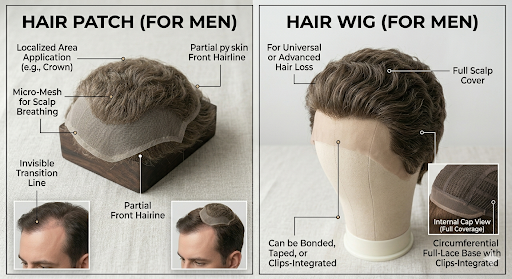
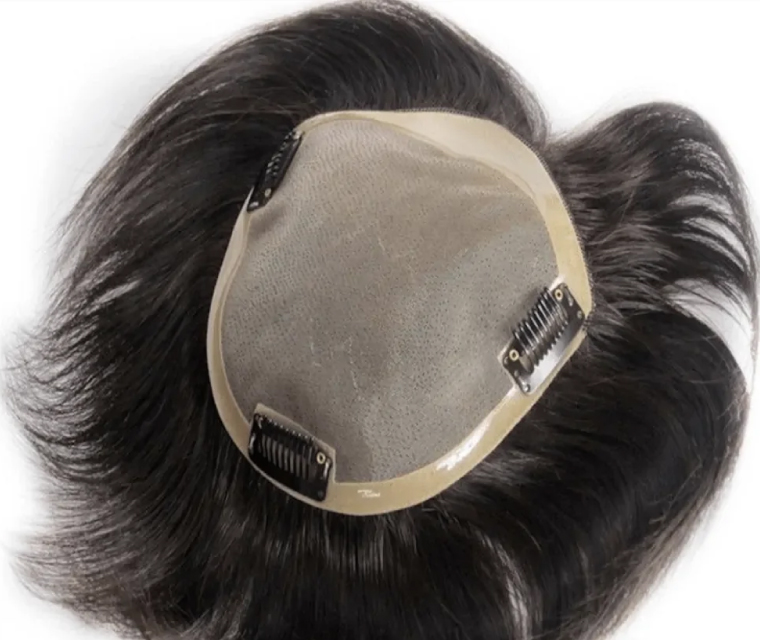
The Golden Mirage is a hair replacement system made from 100 percent natural human hair, bonded directly to the area of loss using medical-grade adhesive, and fitted to integrate with the surrounding natural hair coverage. The base material, hair construction, and attachment method further determine how the solution will perform.
Skin Base Design
The skin base is made from an ultra-thin polyurethane membrane matched to your scalp tone. Under light, it behaves the way actual skin does, which is why the hair appears to grow from your head rather than sit above a visible surface.
At the fitting appointment, the base edge is trimmed to your specific hairline and blended into the scalp. An untrimmed or colour-mismatched edge is what makes patches look detectable, not the hair quality. The fact that a hair patch in Delhi looks natural boils down almost entirely to this base match and edge blending step.
Human Hair Quality
When each strand is individually hand-knotted into the base, it produces the natural variation in direction that biological hair has. This allows the strand to move independently. It also means the patch can be cut, styled, and coloured exactly like your own hair once it is fitted.
Even density calibration is factored in. Natural hair does not grow at uniform density, so a patch with even density reads as artificially full. The hair specialist distributes density across the patch to mirror your existing hair pattern so the coverage blends instead of standing out.
Such nuanced considerations around daily aesthetic make hair patch construction and the resultant longevity a precision-oriented process. Getting both right at the fitting is what separates a system that holds up over months from one that needs constant adjustment.
Secure Attachment Methods
Two main methods are used: tape bonding and adhesive bonding. Tape provides a firm hold suited to standard daily activity and needs re-servicing every four to six weeks. Adhesive provides a stronger, moisture-resistant hold lasting six to eight weeks and is the better choice for patients who exercise regularly or live in Delhi's high-humidity summer conditions.
The method is chosen at the initial consultation based on your scalp condition and daily routine. Getting it right from the start avoids the most common complaint — edge lift between visits — which is almost always the result of a method mismatch rather than a product failure.
Who Can Benefit From the Golden Mirage Hair Patch?
A hair patch may not be the one true answer for every form of hair loss. If you have active follicles that would respond to GFC or PRP, a clinical route makes more sense than covering the result of loss. You are a better candidate for the Golden Mirage hair patch if any of the following apply:
Golden Mirage Hair Patch vs Hair Transplant
These are not competing versions of the same outcome. A transplant and a patch serve different clinical profiles, with the decision depending on how far the loss has progressed and what your donor density currently supports. Most people who choose a patch do so because a transplant is not right for their loss stage or their timeline. Learn more about the difference between a hair patch and a transplant.
| Factor | Golden Mirage Hair Patch | Hair Transplant (FUE) |
|---|---|---|
| Candidacy | Any loss stage; suitable where donor density is insufficient | Requires stable donor area; best for Stage 4 and above |
| Result Timeline | Same-day coverage after fitting | Visible regrowth at 4 to 6 months; full density at 10 to 14 months |
| Permanence | Fully reversible at any point | Permanent; transplanted follicles grow for life |
| Ongoing Maintenance | Re-bonding every 4 to 8 weeks | No maintenance after initial healing |
| Approximate Annual Cost | Rs 36,000 to Rs 96,000 per year in servicing | Single procedure: Rs 80,000 to Rs 2,50,000 |
| Activity Compatibility | Waterproof with correct adhesive | No restrictions after healing |
Maintenance and Care Tips for the Golden Mirage Hair Patch
Getting the maintenance right extends the patch lifespan from six months toward ten months. The fitting appointment is the last step in the journey from identifying hair loss to wearing a fitted patch, typically taking one to two hours. Dr. Aishwarya at Evoke recommends the following routine between scheduled clinic visits.
Washing — Done Every Five to Seven Days
Daily Care Between Wash Days
The Most Common Misconceptions About Hair Patches Addressed Clinically
Three misconceptions come up in almost every hair patch consultation. All three have clinical answers more specific than what most online research provides. Understanding them changes how you evaluate the system before committing.
Whether a patch is detectable depends on base colour matching, edge blending, and adhesive application — not hair quality alone. A skin base matched to your scalp tone and trimmed by a specialist at the fitting is not visible in these settings:
- Ordinary indoor lighting in professional and social settings, including photographs
- Physical contact including handshakes or someone running a hand through your hair
- Standard outdoor settings in ambient daylight at conversational distance
Where it is more likely to be noticed is harsh direct sunlight at very close range and wet hair. Both are manageable through behaviour rather than structural limitations of the system.
The Golden Mirage hair patch with adhesive bonding is compatible with swimming, gym sessions, and outdoor activity. The key is matching the attachment method to the level of activity from the start. Two adjustments make a consistent difference:
- Choose adhesive bonding over tape if you swim regularly or exercise with significant perspiration. The adhesive has stronger moisture resistance than tape.
- Schedule re-bonding at the earlier end of the recommended window. Hold strength reduces with repeated perspiration and movement over weeks.
A patient paying Rs 4,000 to Rs 8,000 per month in servicing will spend Rs 48,000 to Rs 96,000 per year. Over three to four years, that approaches the cost of a mid-range transplant at the same clinic. The case for a patch is based on clinical suitability, not cost savings.
For patients with stable donor density who are strong transplant candidates, the transplant is the more cost-efficient option beyond a four-year horizon.
For patients whose candidacy, loss speed, or preference for reversibility makes the patch the right clinical choice, the servicing cost is part of that trade-off rather than a reason to avoid it.